
Maintenance guide · 6 min read
Why a Sonoma dry-summer kitchen makes the condenser the first thing to clean
Late-summer valley heat, vineyard dust, and a kitchen running flat-out through crush gang up on a Sub-Zero condenser. Why slow cooling out here is so often dust — and how often to clean it.
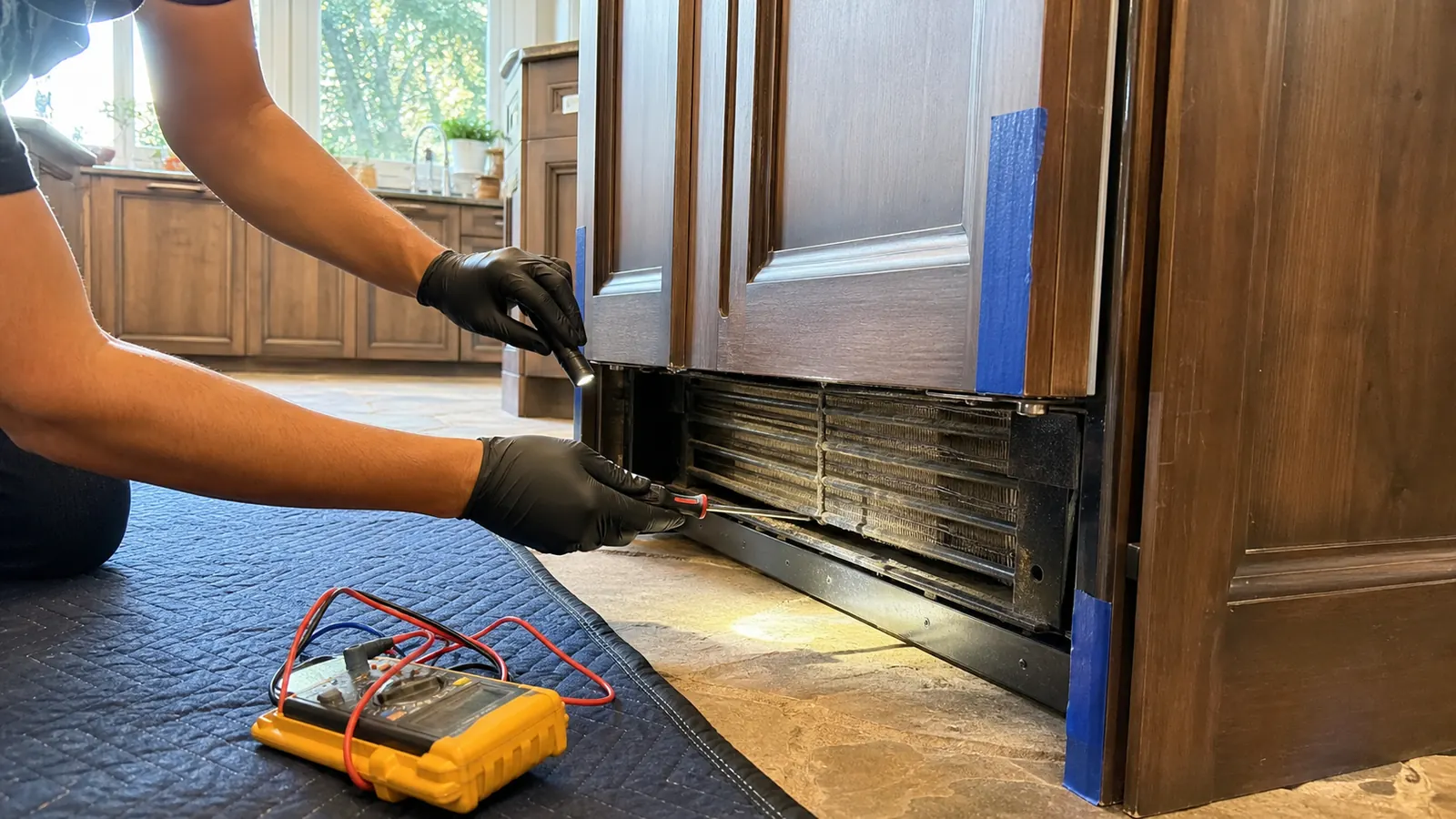
Most of the slow-cooling calls we take between late June and the end of crush turn out to have the same cheap cause, and it is not a part. It is a condenser coil packed with the fine grey dust that hangs over the valley all summer, working against a kitchen that is running harder than it does any other time of year.
The condenser is the radiator that throws a refrigerator's heat back into the room. When it is clean it does that easily; when it is furred with dust it cannot, and the whole unit starts to behave like something far more expensive is wrong. In Sonoma the timing of when that happens is no accident.
Why late summer is the hard season here
From roughly July through harvest the valley floor bakes through long, rainless afternoons, and the air carries a steady load of vineyard soil, mown-cover-crop chaff, and roadside dust that drifts in through every open door and window. That dust settles on the lowest, warmest part of the appliance — the condenser behind the grille — faster than it does almost anywhere else we work.
Then the kitchen itself piles on. A house that hosts through tasting season, a second home filling and emptying every weekend, a fridge and freezer opened a hundred times a day during a crush-weekend dinner: all of it makes the compressor run longer, and a long-running compressor needs that condenser to be clean. Dust plus heat plus a working kitchen is the exact combination that tips a borderline coil over the edge in August and September.
What a dirty condenser looks like from the kitchen
The early signs are easy to read once you know them. The fresh-food side drifts a few degrees warm after a big restock and is slow to recover. The machinery compartment behind the lower grille feels hot to the back of your hand. The unit runs nearly nonstop on a hot afternoon, and you start to notice the fan more than you used to.
All of that imitates a failing compressor or a refrigerant problem, which is why it worries people. But the test is simple: pull the lower grille and look. A coil you can see grey felt on is a dust problem, not a sealed-system problem, and cleaning it usually brings the temperatures and the noise right back down.
How often to clean it on a Sonoma kitchen
The factory rule of thumb is to brush and vacuum the condenser a couple of times a year. Out here we tell owners to treat that as a floor, not a ceiling. A kitchen near working vineyards, on a gravel lane, or running hard through harvest earns a third pass at the start of the dry season, before the heat arrives, so the unit goes into August already clean.
It is a gentle job: power down, lift the grille, vacuum the coil, and brush the fins in the direction they run so you do not flatten them. Homes on a hard well have a second reason to keep a maintenance rhythm, since the same neglect that lets a coil clog also lets scale build in the water lines. If you would rather have it done as part of a once-over, it folds neatly into a seasonal visit.
When it is dust, and when it is a real fault
Cleaning the coil is the right first move, but it is not a cure-all. If the temperatures do not recover within a day of a thorough cleaning, the cause is deeper, and that is the moment to stop guessing and take readings. A unit that is warm across both compartments with a clean coil belongs on the measured not-cooling path; a warm unit paired with a grind or a hard buzz from below belongs on the noise-and-sealed-system path, where gauges settle the question.
The honest version of this advice is that most late-summer slow-cooling in Sonoma is dust, and dust is free to fix. We would rather you clean the coil and save the service call than pay us to tell you the same thing — and when it really is a part, you will know because the numbers will say so after the easy fix has been ruled out.
FAQ
Questions & answers
How often should I clean my Sub-Zero condenser in Sonoma?
At least twice a year, and three times if your kitchen sits near vineyards, on a dusty lane, or runs hard through harvest. Add a cleaning at the start of the dry season so the unit heads into the August heat with a clear coil.
Can a dusty condenser really make the fridge warm?
Yes. The condenser sheds the heat the refrigerator removes; when it is matted with valley dust it cannot, so the compartment drifts warm, the compressor runs almost nonstop, and the unit imitates a far more serious fault. Cleaning the coil usually brings it back.
What if cleaning the coil does not fix the warm temperatures?
Then the cause is deeper than dust, and it is time for real readings rather than more guessing. A unit warm on both sides with a clean coil needs the measured not-cooling diagnosis; a warm unit with a grind or buzz from below needs the sealed-system check, where gauges give the answer.
Go deeper
More Sonoma guides
How Long Do Sub-Zero Refrigerators Last in Sonoma? A Lifespan and Cost Guide
A Sub-Zero built-in lasts 20+ years. Which parts age first, gasket, condenser fan, sealed system, and the repair-vs-replace cost math for Sonoma's older units.
Read the guide → Second-Home Maintenance · 6 minClosing Up a Sonoma Wine-Country Home: Sub-Zero Shutdown and Return Checklist
Closing up a Sonoma wine-country home? How to shut a Sub-Zero down safely, guard old floors from a slow leak, and bring the built-in back when you return.
Read the guide → Wine storage guide · 6 minWhen a Sub-Zero wine column drifts warm in Sonoma wine country
In a valley that takes its cellar temperatures seriously, a Sub-Zero wine column drifting a few degrees matters. The dual-zone faults we see most in Sonoma — and how each is fixed.
Read the guide →After the proof
Rather leave it to a specialist?
Have the failing compartment, current temperatures, and model number ready, and you will get a real first opinion — not a sales pitch.