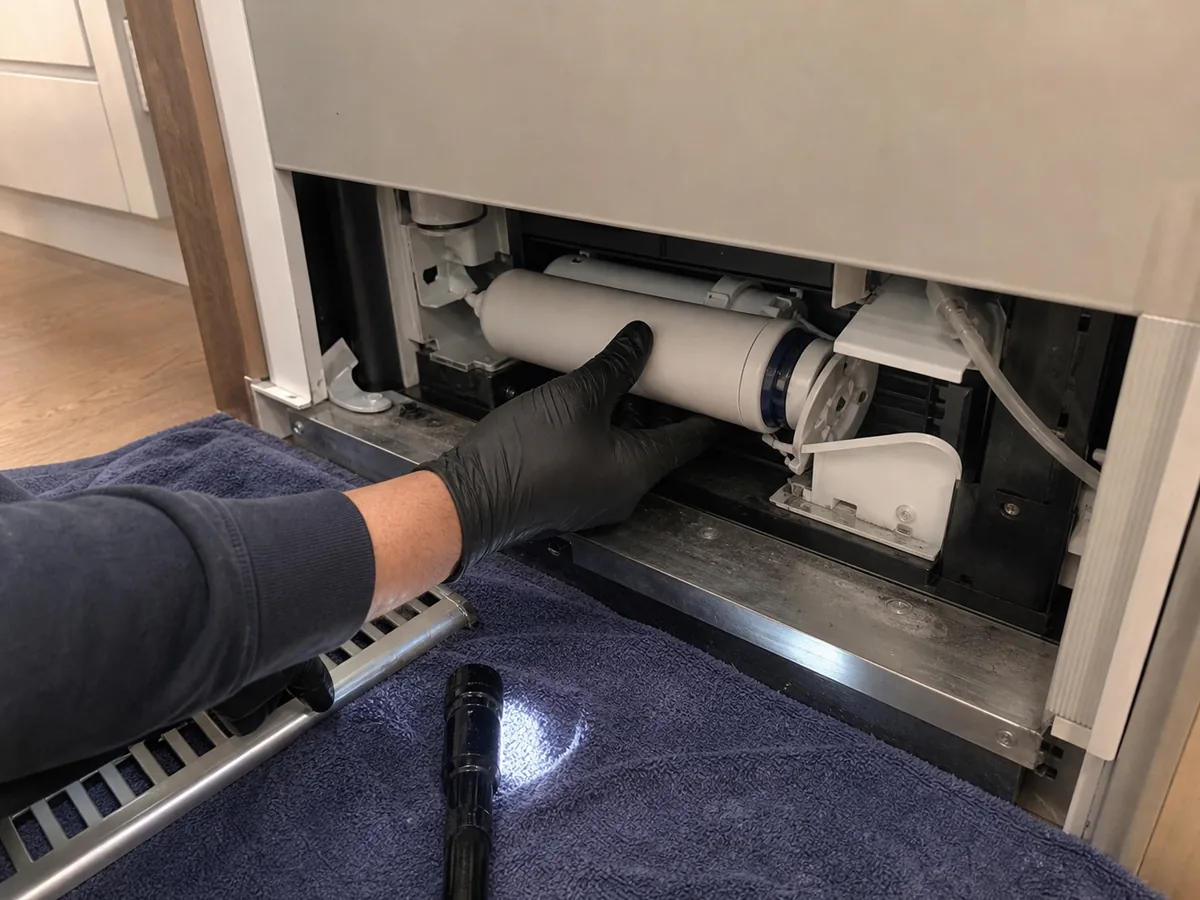
A new noise from a Sub-Zero is a clue, not a verdict. Where it comes from — the condenser fan at the grille, the evaporator fan inside, the compressor, the ice maker, or a loose panel — tells you whether it is routine or a real warning. Here is how to read the sound before you call.
People who own a Sub-Zero get used to a quiet machine, so a new sound stands out — and out here it stands out more than most places. On a still night out in Carneros or on the valley floor, with no traffic to cover it, a straining fan is impossible to ignore, and the call that follows is usually worried.
The reassuring part: most noises map cleanly to a source, and the most common one in Sonoma is also the most benign. Dry summer heat sitting over the valley, plus the steady drift of vineyard and roadside dust, packs the condenser coil and overworks the fan that has to cool it. That single mechanism — heat-load plus dust — is behind a large share of the buzzing and whirring we are called about between June and the end of crush. The map below sorts the rest.
We are an independent repair company, not affiliated with, authorized by, or endorsed by Sub-Zero Group, Inc.
Noise-to-cause map
Match the sound to the part
A whir or grind from the bottom front
Crouch at the lower grille and a steady whirring that turns to a grind or a rattle is the condenser fan. Out here that is the noise we chase most: the fine dust that drifts off the vineyards and the dry valley-floor pollen pack the coil, the fan works harder against the load, and a tired bearing starts to sing. Cleaning the coil and, if needed, renewing the fan motor quiets it and pulls the running temperature back down.
A hum or buzz that comes and goes
A low hum that rises when the unit kicks on and settles after a minute is the compressor doing its job — normal. A hum that turns into a hard electrical buzz, or a click-buzz-click that never settles into a run, is the start circuit or a hardened compressor mount, and that one warrants a look before it strands you warm. The difference is whether the sound resolves into steady running or keeps straining.
A high whine or chirp from inside
Open the door and if the sound grows it is coming from inside the cabinet — almost always the evaporator fan behind the rear panel. A chirp or warble there usually means ice is building on the coil and brushing the blade, or the fan bearing is worn. It often travels with a freezer that is slowly losing its edge, so we check airflow and the defrost cycle together.
A periodic clunk, whir, and trickle
A cycle of a soft clunk, a brief motor whir, and running water every few hours is the ice maker harvesting and refilling — completely normal, just more noticeable in a quiet house. If it grows into a grinding or repeats far too often, the harvest motor or fill valve is the thing to look at, not the sealed system.
A buzz or rattle you can stop by pressing
If you lay a hand on the lower grille or a side panel and the buzz stops, it is vibration, not a failing part — a loose grille, an integrated panel that has worked free, or a foot that is no longer level on an old plank floor. These are quick to chase down and are the most common false alarm we are called out for in older homes.
When a noise is a real warning
Two patterns earn a same-week call. The first is a grinding fan that you can hear from across the room — left alone, a failing fan stops moving air, and a unit that cannot shed or circulate heat drifts warm and overworks the compressor. The second is a hard electrical buzz or a click that repeats without the machine ever settling into a smooth run; that is the start circuit struggling to turn the compressor over, and catching it early is the difference between a small part and a sealed-system bill. If a noise arrives hand-in-hand with rising temperatures, treat it as the warning it is — the sealed-system story is covered on the compressor and sealed-system page.
Before you call
How to locate the noise yourself
Listen at the lower grille first
Most mechanical noise lives at the front bottom. A whir or grind there is the condenser fan; a hum that rises and falls with the cycle is the compressor. Note whether it grinds, buzzes, or simply hums.
Open the door and compare
If the sound gets louder with the door open, it is the evaporator fan inside the cabinet. If it gets quieter, the source is the machinery compartment below. This one test splits inside-faults from outside-faults.
Press the grille and panels
Gently push on the lower grille, the side panel, and any integrated front panel. If the buzz or rattle stops while you press, you have a vibration rattle — a loose part, not a worn one.
Note when it happens
Is it constant, or only during a cooling cycle, an ice harvest, or the small hours when the valley goes silent? A cyclic noise tied to ice or defrost is usually normal; a constant grind or strain is not.
Photograph the model tag and book
If the noise is a fan, a straining compressor, or anything paired with rising temperatures, capture the model-and-serial tag and book. That lets us match a fan motor or start component to your unit before the visit.
Vibration, wine, and what it costs
In a wine-country kitchen the quietest fault can be the most consequential. A low vibration from a worn bearing or a hardened mount travels through cabinetry into an adjacent wine column and, given months, stirs sediment in bottles laid down to age. We treat vibration as a real fault and chase it to its source — there is background on the cellar side in the wine-storage and refrigerant-law guide.
As for cost, most noise calls are at the affordable end: a coil cleaning, a fan motor, or re-seating a loose panel. A start component is modest; only a genuine compressor or refrigerant fault sits in the upper range, and we never call that without proof. The planning ranges are laid out on the diagnostic fees and pricing page, and the $89 service call goes toward the repair.
FAQ
Sub-Zero noise questions
Is it normal for a Sub-Zero to hum at night?
A soft, steady hum that rises when the compressor starts and eases as it runs is normal — you simply hear it more once a quiet Carneros or valley-floor evening goes still. What is not normal is a hum that hardens into an electrical buzz or a repeating click that never settles into a smooth run; that points to the start circuit or a worn mount and is worth a look.
Why did my Sub-Zero suddenly get loud this summer?
Dry-August heat over the valley combined with vineyard and pollen dust is the classic cause. A condenser coil furred with that dust forces the fan to spin harder and longer, which is both the noise you hear and a unit running warmer than it should. A coil cleaning is the first and often the only fix needed.
Can the noise actually affect my stored wine?
Over time it can. A worn fan bearing or a compressor mount gone hard sends a constant low vibration into a built-in wine column that, month after month, can disturb the sediment in older bottles meant to rest. We trace the vibration to its source and quiet it rather than masking it — there is more on that on the wine-storage refrigerant-law page.
It buzzed loudly and now it is warm — is the compressor dying?
Maybe, but do not assume it. A hard buzz followed by warming can be a failed start component the compressor needs to run, which is a far smaller repair than the compressor itself. We put the readings in front of you and only call a sealed-system fault when the pressures and electrical tests prove it.
Quiet it at the source
Book a Sub-Zero noise diagnosis in Sonoma
Describe the sound and where it lives, have the model tag ready, and you will get a clear price before any work begins.